A recurring complaint on this site is that students are asked to talk about mathematics before they can do any. The objection has never been to the talking. It is to the order. Blackjack is a useful place to watch the consequences of getting that order wrong, because it is one of the few settings in which large numbers of adults perform a probability calculation in public, with money on the outcome, and make errors that can be named precisely.
The game is finite. There are fifty-two cards, a short list of legal actions, and a dealer who makes no decisions whatsoever, since house rules oblige the dealer to draw to sixteen and stand on seventeen. Every choice the player faces therefore collapses to a comparison of two or three numbers. Baldwin, Cantey, Maisel and McDermott published the first careful attempt at those numbers in the Journal of the American Statistical Association in 1956, computed on desk calculators over a period of months. What came out of that work is now called basic strategy. It is not a collection of tips. It is the printed output of an exhaustive calculation, and it has the same standing as a table of logarithms.
The expected value of a decision is the sum of every possible result weighted by its probability. That definition fits on one line, and it is the whole of the theory here; the difficulty is never conceptual, it is arithmetic. Grinstead and Snell set the machinery out at undergraduate level in Introduction to Probability, published by the American Mathematical Society and available in full. Basic strategy is what you get by computing the expected value of each legal action in each of a few hundred situations and keeping the largest.
The insurance bet shows the method at its cleanest. When the dealer shows an ace, the player may stake half the original wager on the proposition that the hole card is worth ten, and is paid two to one if it is. Four of the thirteen ranks are ten-valued and the remaining nine are not. The expected value of a one-unit insurance bet is therefore (4/13)(+2) + (9/13)(-1), which is -1/13, or a loss of about 7.7 cents per dollar staked. That number does not move when the player is holding a good hand, and it does not move when the player feels due. It is a property of the deck. A student who can carry out that calculation has understood conditional expectation better than a student who can write a paragraph about risk.
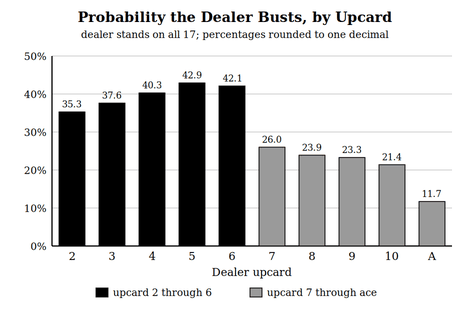
Because the dealer's play is forced, the probability that the dealer eventually exceeds twenty-one can be computed exactly for each upcard. Those probabilities are the reason basic strategy looks the way it does.
Note the shape. The dealer is at greatest risk holding a five, marginally more so than holding a six, and the two-through-six range is nowhere near as dangerous for the dealer as casual players assume; even the worst column leaves the dealer standing more often than not. The drop between six and seven is the largest step in the chart, and it is the reason the strategy table changes character at that column. None of this is available by inspection. It comes from summing over draw sequences, which is tedious, and which is exactly the kind of work the programs criticized in our glossary of terms tend to hand to a calculator before a student has any feel for what is being summed.
Ask a room of people whether to hit a hard sixteen against a dealer seven and most will stand, on the grounds that drawing risks an immediate loss. The grounds are real; the conclusion is backwards. Standing has its own probability of losing, which is simply the probability that the dealer finishes with seventeen or better, and against a seven that probability is large. Hitting sixteen against a seven is better by roughly seven hundredths of a unit. Against a dealer ten the two lines nearly coincide, and the gap is a few ten-thousandths. No amount of experience at the table will resolve a difference that small in either direction. Only the calculation will.
This is a conditional probability error of the most ordinary kind. The player is comparing the risk of one action against zero rather than against the risk of the alternative. It is the same error that produces bad reasoning about medical screening and about insurance, and it is not repaired by encouraging students to explain their thinking. It is repaired by making them compute both branches.
Everything above assumes a particular rule set. Change the rules and the numbers change with them, by amounts that are themselves computable. Under common multiple-deck rules a player using basic strategy perfectly gives up about half a percentage point. Paying six to five on a natural instead of three to two, a change that looks cosmetic, costs the player about 1.4 percentage points, which is to say it roughly quadruples the house edge on its own. Whether the dealer hits a soft seventeen is worth about two tenths of a point. The number of decks matters, though less than most players think.
None of this is confined to a felt table in a resort town. Most people who meet the game now meet it on a screen, where the rule set is written in a help file rather than announced by a pit boss, and where the parameters that decide the arithmetic are stated openly. Listings of online blackjack casinos Canada players can reach, among them an Ottawa Citizen guide to online blackjack, record deck counts, soft-seventeen rules and payout ratios in adjacent columns. For a student the interesting thing is not which entry sits at the top of such a list. It is that the list is a table of parameters, and that moving one entry shifts the expected value by a quantity somebody has already worked out.
The expected loss per hand under good play is around half a cent on the dollar. The standard deviation per hand is about 1.15 units, more than two hundred times as large. Over a hundred hands the expected loss is half a unit and the standard deviation is eleven and a half units. The signal is buried, and it stays buried for far longer than an evening.
That ratio is the real lesson, and it generalizes well beyond the game. Anyone who plays badly for one session and wins has been handed vivid personal evidence for a false proposition, and anyone who plays correctly and loses has been handed the same evidence for the true one. Experience does not distinguish between the two hypotheses at this sample size. Only the underlying computation does, which is a fair description of why controlled trials exist.
The San Diego Mathematics Standards reproduced on this site carry a strand headed Data Analysis, Statistics, and Probability at every grade from kindergarten upward. The strand is not the issue. What matters is whether a student leaves school able to set up an expectation and evaluate it, or merely able to discuss uncertainty in general terms, and that distinction is the substance of the argument set out in What is Changing in Math Education?
Blackjack is a probability lesson wearing a disguise, and the disguise is the only reason anybody practices the lesson for hours at a stretch. The mathematics on offer is elementary. Weighted averages, conditional probability, the distinction between an expectation and a realization. A curriculum that delivers those three things reliably would leave a graduate able to work out for himself, in about a minute and with no chart in front of him, that the insurance bet is a poor one.